I first got into technology from reading books such as 1001 Wonders of Science by Brian and Brenda Williams and 366 Questions and Answers by Brown Watson. My childhood was filled with stories such as Hero of Alexandria, the fastest planes that existed at the time, dinosaurs and Sunday afternoon narrations from David Attenborough. It was fascinating how everything seemed to mesh and collapse into each other. A kind of retrofuturism that I admired. This was in the early 2000's and right after the 1999 IT debacle where there was a muddle of 'everything is possible' , 'we need to be cautious' and 'the world has gone to doom'.
Rightly so, play, for me, translated to toying with magnets, using magnifying lenses as cookers, charcoal coolers, some DIY water filters and every once in a while, mixing up concoctions to inject into plants to see what could possibly happen - an echo of Letters to a Young Scientist by Edward O. Wilson. These early experiences molded my mental fortitude in chasing scientific evidence, going against the grain and building a new, effectively guiding my choices on what I wanted to do.
The concept of futurism has been in existence ever since the industrial revolution ( steampunk, archeofuturism, atom-futurism, solar-punk and cyberpunk). Consequently, each generation has had its brush and influence based on the time period. For once, steampunk celebrated the mechanical ingenuity of steam power, archeofuturism longed for a fusion of ancient wisdom with modern ambition, while cyberpunk questioned the ethics of unchecked progress and solarpunk imagined harmony between nature and technology. I find myself drawn to these visions — not because they predict the future accurately but because they expose our collective hopes and anxieties - AGI placed in frame.
What do we foresee in our near future ? Does technology have any say into what we see or choose not to?
Not withstanding, our advancement has led to just as many problems as the alleviation it has created. For one, we created printing that helped diffuse the work of Issac Newton just as much as Luther's Theses contributed to the St. Bartholomew’s Day Massacre and the Thirty Years’ War. Similarly, we created intelligence to help speed up solving climate change in the same breath as we cut down our forests to create data centers. Should you dare go back a step, soar the air to explore just as much as we started using planes for warfare barely a decade later.
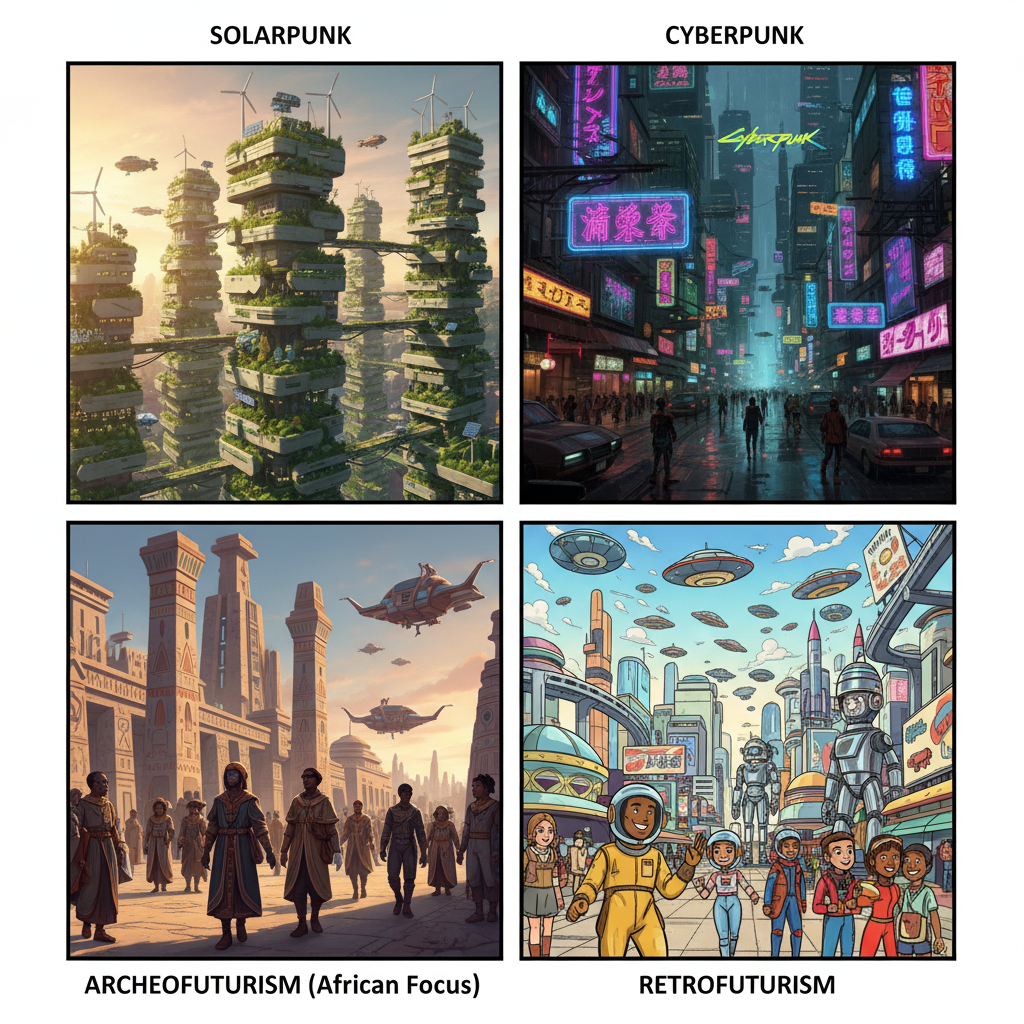
Indulge: Do we march forward with wisdom from the past, anchor ourselves in myth and tradition - or run to a future 1001 possibilities?
We are left to ponder. What path do we lean on today? What impact does it have on our futures? How essential is it to the future we want?
As I have come to learn from science so far, scientists that 'make it' are those that take the unbeaten path. Those that seek science for curiosity sake. As Wilson would have it:
" If a subject is already receiving a great deal of attention, if it has a glamorous aura, if its practitioners are prizewinners who receive large grants, stay away from that subject. Listen to the news coming from the current hubbub, learn how and why the subject became prominent, but in making your own long-term plans be aware it is already crowded with talented people. You would be a newcomer, a private amid bemedaled first sergeants and generals. Take a subject instead that interests you and looks promising, and where established experts are not yet conspicuously competing with one another, where few if any prizes and academy memberships have been given, and where the annals of research are not yet layered with superfluous data and mathematical models. You may feel lonely and insecure in your first endeavors, but, all other things being equal, your best chance to make your mark and to experience the thrill of discovery will be there."
Charting your future in the plethora of choices requires a certain gusto. It requires avid dreaming and imagination. Your task is to waddle through the noise to find what you want and pursue it as long as it gives you personal fulfillment. The best way to do this? Perform small , informal experiments. The risk of time is small but the mine that you might stumble upon ... Your task is to disturb nature and see if she reveals her secrets - a direct correlation to futurism not required.
Obey your passion for as long as it lasts , sample other subjects and be smart enough to switch to a greater love should one appear. You, in the end, are a summation of the content you consume, the circles you engage and the adventures you pursue. Perhaps the future has always been less about what we build, and more about what we dare to believe is possible - what tickles our curiosity.
Amidst the punk and futurism lies the next philosophy: one that acknowledges the algorithm without surrendering the soul. One that honors the data but still seeks meaning beyond it. One that does not drown in et al. I choose to live as a research scientist at the fault line of wonder and consequence — chasing the same awe that once lit my childhood, now tempered by the weight of knowing what it costs to build.
PS: Despite all circumstances, you author your future.